Guides
Cremation caskets: renting, buying, types and costs
Choosing a casket is one of the first decisions families face when planning a cremation, and it is often the single largest expense. This guide walks through what a cremation casket actually is, how the choice between renting and buying works, and the real cost ranges for each. It also covers the main casket styles and materials available, so you have enough to talk it over with family and friends and reach a decision you feel settled about.
What is a cremation casket?
A cremation casket is the container that can be used during the funeral service, any viewing, and the cremation itself. If you choose a low-cost direct cremation with no service or viewing, the first two uses fall away and a basic container is all you need. Options start from as little as around $120 for a cardboard cremation container.
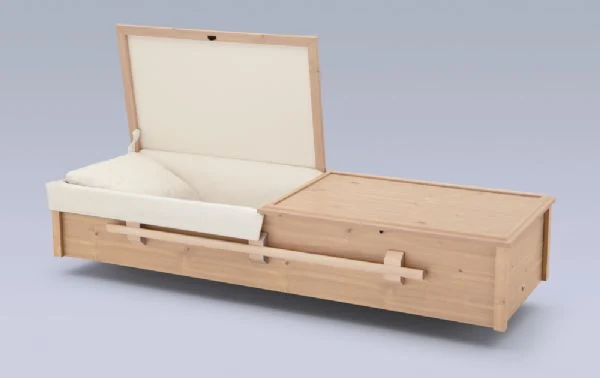
Whatever you choose, the casket must be fully combustible and leak-proof, with no metal parts. Fabrics and linings are optional, but they must meet the crematory's criteria for cremation.
Caskets come in a range of materials, most commonly cardboard and wood, and some are eco-friendly and biodegradable. These greener options have become very popular in the last few years. You also have the choice to buy a casket outright or rent one, which we cover in detail below.
What happens to the casket during cremation?
The casket is cremated together with the body in a furnace that heats to roughly 1,400 to 1,800 degrees Fahrenheit. Once the process is complete, what remains is bone fragments along with any metal, such as the nails from the casket.
The bone fragments are then reduced to the fine ashes that families receive as the cremated remains. The remains weigh around 7 pounds for a man and about 5 pounds for a woman. You will also receive a Certificate of Cremation, a legal document carrying the person's name along with the date and place of cremation.
Once the ashes are returned, families usually place them in an urn before deciding what comes next. That might mean keeping them, scattering them in the wind, from a plane, into the ocean, or wherever the person's favorite place was, or sending them to family interstate or overseas.
What different cultures say about the body and the soul
Beliefs about cremation and what should happen to the body vary widely between traditions. If you are planning around a particular faith, it is worth speaking with a faith leader, but here is a short overview of where several traditions stand.
Buddhism
Cremation is widely accepted. The teaching is that attachment to the dead can be detrimental to the progress of the soul as it seeks a new life after death, so letting go is part of the process.
Catholicism
The Catholic Church permits cremation but does not accept the scattering of ashes. The teaching is that the body is to be treated as a whole and kept as such, interred rather than dispersed.
Islam
Cremation is strongly disapproved of. The body is bathed and wrapped in cloth for burial, in keeping with Islamic tradition.
Judaism
Orthodox Jews strictly forbid the practice of cremation, favouring prompt burial of the intact body.
Hinduism
Cremation is central to Hindu practice, and the ashes are not permitted to return home. They must be scattered within 14 days of the cremation, and it is recommended that they be cast into the river Ganges. Those performing the scattering are expected to leave without glancing back.
Jehovah's Witnesses
Cremation is accepted, with no religious objection to the practice.
What can you leave inside the casket?
Many families want to send a loved one off with a cherished possession, but this is generally not recommended for the cremation process. Items made of metal, such as jewelry, will not be reduced to ash and have to be removed beforehand.
Often the kindest choice is to keep meaningful belongings intact so they can continue to represent that person in your life. If you do want to place something inside, always tell the crematory staff in advance and they will let you know whether it is possible.
If you would like a lasting and more creative keepsake instead, a portion of the ashes can later be turned into cremation glass art, including customized pieces such as glass orbs, paperweights or jewelry, or even into a cremation diamond.
Can you rent a casket?
Yes, you absolutely can. A rental casket is a practical option for families who want a traditional-looking casket for the funeral service or viewing, but would rather not carry the large expense of buying one that will be cremated.
What a rental casket looks like
A rental casket looks exactly like any other casket, made of wood or metal with a glossy finish. The only difference is that it is reused many times over. You rent it for the service along with a pillow and a removable cloth, which keeps everything sanitary so the casket can be used again.
How renting a casket works
The deceased is first placed into a simple alternative container, which is the container they will actually be cremated in. For the service, that container is carefully inserted into the rental casket along with a protective sheet, so at no point does the body make contact with the rental casket itself. After the service, the inner container is removed and taken on its last journey to the cremation room, and the family is given a 'looks like new' casket for the ceremony.
What the service looks like
A cremation funeral service usually takes about 30 to 40 minutes. The casket is raised on a platform that is often decorated with flowers. A religious or non-religious ceremony is then held. For a particular denomination you will need to contact your faith leader, while non-religious ceremonies are led by a celebrant who is more flexible and can tailor the service to be religious, spiritual, or somewhere in between. The service ends with the committal, when the casket is either lowered or withdrawn through a gate.
Rental costs
A rental casket typically costs between $700 and $1,000, plus an additional $150 to $250 for the removable pillow and cloth. By comparison, a traditional casket bought outright costs around $4,000 to $6,000, which is at least four times the cost of renting.
How much do cremation caskets cost?
A standard cremation casket can run anywhere from about $80 to $3,000 depending on the material and finish you choose. For most families, the casket is probably the single biggest expense in the overall cost of cremating a loved one.
The other major decision that drives the price is whether to hold a funeral service. A traditional casket bought for a full service can cost roughly $4,000 to $9,000, while renting a casket and adding a simple cremation container instead lands closer to $1,080 to $4,000. If keeping costs down is a priority, comparing direct cremation pricing alongside these figures is a sensible next step.
Types of cremation caskets
Beyond the rent-versus-buy question, the main choice is the casket itself. The most common options are a cardboard cremation container, a green biodegradable casket, or a plain Jewish plywood casket. Each is covered more closely below.
Cardboard cremation caskets
Cardboard caskets, also known as alternative containers, are both budget-friendly and eco-friendly, saving trees and money at the same time. The ones we looked at ranged from about $135 to $795. They have become very popular over the last five years, largely thanks to digital printing, which lets you decorate the container however you wish. You can also choose between a coffin shape and a simple rectangular shape, which is a completely personal choice. They are made from 100% biodegradable material, using corn-starch glues, a wax-coated lining and natural rope or fabric handles.
Green cremation caskets
If you care about nature and want the cleanest possible ashes, a green casket is worth considering. These biodegradable caskets are made from natural materials such as cotton, wool, bamboo and wicker. There is also a recycled option, made from recycled paper or cardboard reinforced with wooden fibers for stability. They are made to resemble a traditional casket, are lightweight and fully combustible, and tend to be a more affordable choice compared with renting, while offering the cleanest ashes possible.
Jewish caskets
Jewish caskets are made entirely of plywood, again with no metal parts included. The simple, all-wood construction is fully combustible, which makes it a good fit for cremation while keeping in step with the tradition of a plain, natural casket.
FAQ
Cremation caskets: renting, buying, types and costs: common questions
- What is the cheapest cremation casket option?
- The most affordable option is a basic cardboard cremation container, with prices starting from around $120. The cardboard caskets we reviewed ranged from about $135 to $795, making them the budget-friendly choice for both direct cremation and simple services.
- Is renting a casket cheaper than buying one?
- Usually, yes. A rental casket runs about $700 to $1,000 plus $150 to $250 for the pillow and cloth, while a traditional casket bought outright costs around $4,000 to $6,000. Renting can be at least four times cheaper for a service casket.
- Does the casket have to meet special requirements for cremation?
- Yes. A cremation casket must be fully combustible and leak-proof, with no metal parts. Fabrics and linings are optional but must meet the crematory's criteria.
- Can I leave personal items inside the casket?
- It is generally not recommended, especially metal items like jewelry, which will not be reduced to ash and must be removed. If you want to include something, tell the crematory staff in advance so they can advise whether it is possible.
- How much do the cremated remains weigh?
- Cremated remains weigh around 7 pounds for a man and about 5 pounds for a woman. Families also receive a Certificate of Cremation recording the person's name along with the date and place of cremation.
When you’re ready to look at costs
See what's fair where you live before any provider quotes you.

About the author
Adam Binstock
Founder of Cremation Institute
Keep reading
Related guides
Planning a cremation?
See what a direct cremation should cost where you live, and compare trusted providers before you pay for extras you may not need.
Direct cremation costs →